
January 2026.
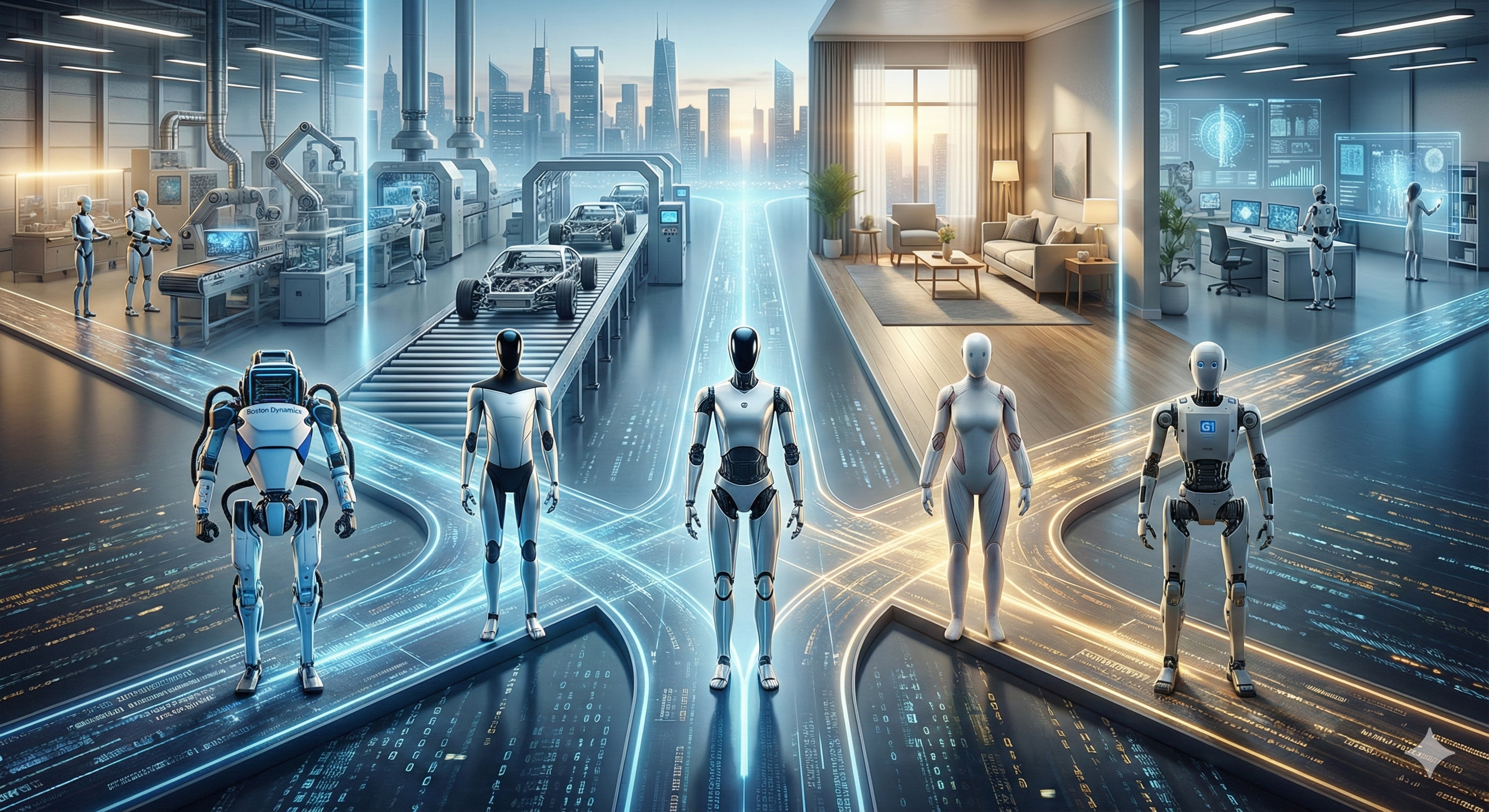
The humanoid robot market is transforming rapidly.
Boston Dynamics announced Electric Atlas commercialization at CES.
Tesla previewed Optimus V3 and declared plans for a million-unit production line.
1X Technologies’ NEO has begun shipping to American homes.
Figure AI’s Figure 03 completed 11 months of real-world testing at BMW factories.
These are no longer prototypes.
The era of competition as products has begun.
This article analyzes the structural differences between major humanoid robots.
Beyond spec comparisons, we read the strategic directions each company has chosen.
1. Market Structure: Three Battlegrounds
The humanoid robot market divides into three domains.
Industrial
Factories, logistics centers, warehouses.
Replacing repetitive and dangerous tasks.
Key requirements:
– High payload (20kg+)
– Long uptime (continuous operation)
– Integration with existing systems (MES, WMS)
– Reliability and predictability
Major players: Boston Dynamics Atlas, Figure 02/03, Tesla Optimus
Home
Household chores, elderly care, daily assistance.
Safety and user experience are paramount.
Key requirements:
– Extreme safety (injury prevention on collision)
– Low noise (under 22dB)
– Intuitive interface (voice commands)
– Learning capability (acquiring new tasks)
Major players: 1X NEO, Figure 03, Tesla Optimus (long-term goal)
R&D / Education
Universities, research labs, startups.
Accessibility as a development platform matters.
Key requirements:
– Affordable price
– Secondary development support (API, SDK)
– Modular hardware
– Active community
Major players: Unitree G1, Unitree H1
2. Major Robot Analysis
Boston Dynamics Electric Atlas
Position: Industrial Premium
After a decade of research, commercialization has arrived.
In April 2024, hydraulic Atlas retired and the electric version emerged.
At CES January 2026, the product version was unveiled.
Key features:
– Joint design exceeding human range of motion (360-degree rotation)
– Autonomous battery swapping (continuous operation without interruption)
– Pilot testing at Hyundai automotive plants
– Partnership with Google DeepMind (foundation model integration)
Estimated price: $420,000
Strategic choice:
Atlas chose “peak performance.”
Capability over price.
Building on proven commercialization with Spot and Stretch,
targeting high-value industrial customers.
Tesla Optimus
Position: Mass-Production General-Purpose Robot
Tesla’s true ambition may not be cars.
Elon Musk repeatedly says Optimus will become Tesla’s biggest business.
Key features:
– 173cm, 57kg (human-like form factor)
– 22 DoF hands (Gen 3)
– Leveraging FSD (Full Self-Driving) AI stack
– 1 million unit production line target by end of 2026
Estimated price: $20,000-30,000 (at mass production)
Reality check:
The 2025 goal of 5,000 units reached only hundreds.
A leaked video showed the robot falling at a Miami demonstration.
Scale strategy is outpacing technical completion.
Strategic choice:
Tesla chose “economies of scale.”
Leveraging automotive supply chains and manufacturing capabilities
to target prices no one else can match.
A bet that time will solve the completeness problem.
Figure AI Figure 03
Position: General-Purpose Humanoid (Industrial → Home Expansion)
Founded 2022, $2.6B valuation in 2024.
Backed by Jeff Bezos, Microsoft, NVIDIA, OpenAI.
The startup closest to commercialization.
Key features:
– Helix: Proprietary Vision-Language-Action model
– System 1 (200Hz low-level control) + System 2 (7-9Hz high-level planning)
– Wireless inductive charging (2kW, dock with feet)
– 11 months real-world testing at BMW factory (99%+ placement accuracy)
– 12,000 units/year production facility (BotQ)
Estimated price: $100,000+ (industrial pilot)
Strategic choice:
Figure chose “data flywheel.”
Factory deployments collect real task data,
which feeds back into Helix model improvement.
More deployments → More data → Better AI → More deployments.
1X Technologies NEO
Position: Home-Specialized
Claims to be the first consumer-ready humanoid.
US shipping begins 2026, global expansion in 2027.
Key features:
– 167cm, 30kg (lightweight and quiet, 22dB)
– Tendon Drive: tendon-based actuation (biomimetic)
– 70kg lifting, 25kg carrying capacity
– 22 DoF hands (human-level dexterity)
– Redwood AI: proprietary Vision-Language model (on-device)
– “1X Expert” remote teaching system (learning new tasks)
Price: $20,000 (Early Access) or $499/month subscription
Strategic choice:
NEO chose “home entry.”
They argue homes are harder than factories.
Unstructured environments, diverse objects, direct human interaction.
But data collected in homes may be
the fastest path to general-purpose AI robots.
Unitree G1 / H1
Position: Low-Cost Research Platform
China’s Unitree attacks the market with price disruption.
G1:
– 127cm, 35kg (compact)
– 23-43 degrees of freedom
– $13,500-16,000
H1:
– 180cm, 47kg (full-size)
– World record speed 3.3m/s
– ~$90,000
Strategic choice:
Unitree chose “accessibility.”
Providing affordable platforms to researchers and startups,
expanding the ecosystem.
A bet that hardware commoditizes and value moves to software.
3. Core Technology Comparison
Actuation Method
| Robot | Method | Features |
|---|---|---|
| Atlas | Electric (formerly hydraulic) | Beyond-human range of motion |
| Optimus | Electric | Automotive tech transfer |
| Figure 03 | Electric | Wireless charging integrated |
| NEO | Tendon Drive (electric) | Biomimetic, low noise |
| G1/H1 | Electric | High efficiency, low cost |
The transition from hydraulic to electric is industry-wide.
NEO’s Tendon Drive is unique—
mimicking tendon structure for natural, safe movement.
AI Architecture
| Robot | AI Approach | Features |
|---|---|---|
| Atlas | Google DeepMind LBM | External partnership |
| Optimus | FSD stack transfer | In-house, integrated |
| Figure 03 | Helix VLA | In-house, dual system |
| NEO | Redwood AI + LLM | On-device, conversational |
| G1/H1 | Open (user development) | Platform-centric |
VLA (Vision-Language-Action) models are the trend.
Language understanding → Visual perception → Action generation, unified.
Figure’s Helix and 1X’s Redwood lead this direction.
Pricing Strategy
| Robot | Estimated Price | Target |
|---|---|---|
| Atlas | $420,000 | Enterprise |
| Optimus | $20,000-30,000 (goal) | Mass market |
| Figure 03 | $100,000+ | Enterprise pilot |
| NEO | $20,000 / $499/mo | Consumer |
| G1 | $13,500-16,000 | Researchers |
| H1 | ~$90,000 | Research/Industrial |
The price spectrum is wide.
A 30x difference between Atlas and G1.
This means targeting different markets.
4. Analysis Through the Physical AI Lens
Let’s examine how concepts from this series apply to each robot.
Sim-to-Real Gap
All companies use simulation training.
But reality adaptation strategies differ.
– Tesla: Massive real-world data collection in own factories
– Figure: Real-world data from BMW pilots
– 1X: Human demonstration data via teleoperation
– Boston Dynamics: Long-term testing at Hyundai facilities
Methods for reducing the Sim-to-Real Gap vary,
but ultimately the quantity and quality of “real-world data” decides the winner.
Domain Randomization
Domain Randomization is central to simulation training.
Figure’s Helix claiming it “can pick up thousands of objects zero-shot”
is the result of training in sufficiently diverse randomized environments.
NEO’s “Expert Mode” is an interesting variation.
Instead of simulation randomization, human expert teleoperation
directly learns real-world diversity.
World Foundation Model
NVIDIA Cosmos and similar World Foundation Models
haven’t been directly integrated into these robots yet,
but Figure AI and 1X are notably collaborating with NVIDIA.
Synthetic data generation → Increased simulation diversity → More robust policies.
When this chain completes, Physical AI’s next phase opens.
5. Who Will Win?
There’s no simple answer.
Industrial market:
Boston Dynamics maintains technology leadership,
but Figure AI is catching up fast.
Tesla will expand after validation in its own factories.
Home market:
1X NEO may enjoy first-mover advantage,
but true value proof for home robots remains ahead.
If Tesla succeeds at mass production, the landscape shifts.
Research platform:
Unitree’s low-price strategy is expanding the ecosystem.
Many startups and labs are developing on G1/H1.
The most important variable is the data flywheel.
More robot deployments → More real-world data → Better AI → More value → More deployments.
The company that spins this cycle fastest wins.
Closing: Concluding the Physical AI Series
In this series, we explored:
1. What is Physical AI: The structural difference from Software AI
2. Sim-to-Real Gap: The chasm between simulation and reality
3. NVIDIA Cosmos: The structure of World Foundation Models
4. Domain Randomization: Building robustness through randomness
5. Humanoid Robots Compared: The 2026 market landscape
Physical AI is no longer a distant future.
In 2026, humanoid robots are working in factories
and beginning to ship to homes.
The remaining question is not “is it possible?”
It’s “who, how, and how fast?”
I hope this series provided a structural framework for answering that question.
Leave a Reply