
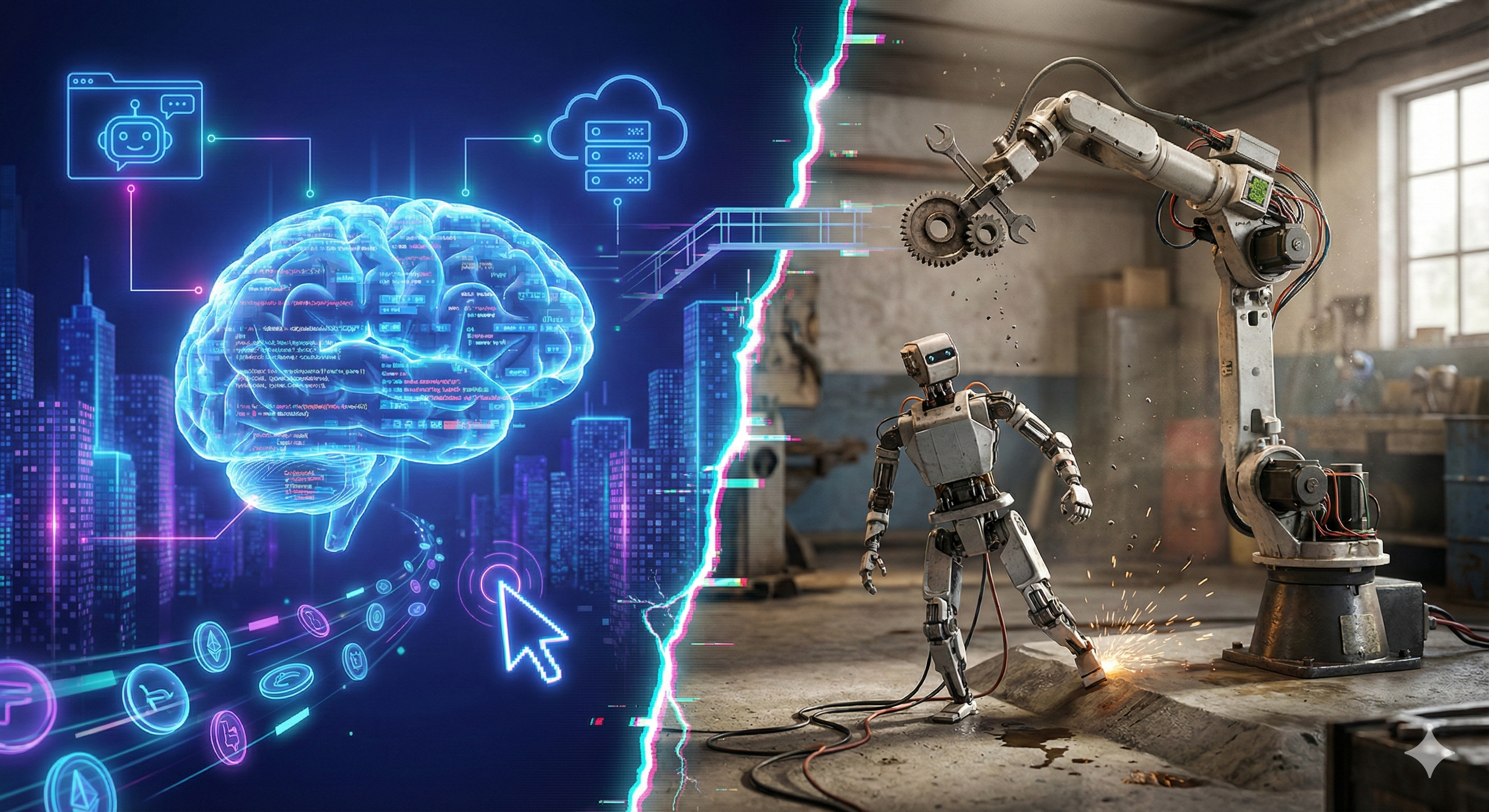
A robot falls.
The same robot that walked flawlessly in simulation
loses its balance on an uneven floor in the real world.
This isn’t merely a technical failure.
It’s a moment that reveals the structural gap
between Software AI and Physical AI.
1. The Fourth Wave of AI
NVIDIA CEO Jensen Huang describes AI’s evolution as four waves.
The first was Perception AI.
Classifying images, converting speech to text.
The moment AI began to “see” the world.
The second was Generative AI.
Represented by ChatGPT, this wave brought
the ability to “create” text and images.
The third is Agentic AI.
AI that reasons, plans, and acts autonomously.
Digital entities that move independently within the virtual world.
And now, the fourth wave—
Physical AI—has just begun.
“The ChatGPT moment for general robotics is just around the corner.”
Huang’s declaration isn’t mere marketing.
The projected growth of the Physical AI market
from $4.1 billion in 2024 to $61.2 billion by 2034
provides the foundation for this claim.
2. Structural Difference: The Boundary Between Digital and Physical
The difference between Software AI and Physical AI
isn’t simply about having a body or not.
The structure of operation itself is fundamentally different.
The World of Software AI
ChatGPT operates within the flow of tokens.
It interprets input text as probability distributions
and selects the most plausible next token.
In this world, “mistakes” are recoverable.
Wrong answers can simply be regenerated.
Time is linear, and outcomes are reversible.
Most importantly,
Software AI operates within a closed system.
Physical laws don’t intervene between input and output.
The World of Physical AI
Robots are different.
There’s gravity.
There’s friction.
There are unpredictable obstacles.
Physical AI operates within an open system.
Sensors perceive the world,
motors intervene in the world,
and the results feed back to the sensors.
This feedback loop operates in real-time.
A 0.1-second delay can lead to a fall.
A single collision can cause hardware damage.
As Embodied AI researchers point out:
“While traditional disembodied AI relies on abstract data processing,
Physical AI emphasizes the importance of physical interaction,
perception, and motion.”
This is the core structural difference.
3. Four Pillars: The Operating Structure of Physical AI
Physical AI systems consist of four essential components.
Perception
Cameras, LiDAR, ultrasonic sensors, tactile sensors.
Robots understand the world by fusing these diverse senses.
What’s fascinating is the structural similarity to human perception.
Just as we don’t walk using only our eyes,
robots don’t rely on a single sensor.
The computer vision market reaching $19.8 billion in 2024
with 19.8% annual growth reflects this reality.
Investment in the “eyes” of Physical AI is intensifying.
World Models
Before a robot acts,
it must first “understand” how the world works.
Push an object, and it moves.
Walk down stairs, and height decreases.
Drop a glass, and it breaks.
A World Model is trained on this physical common sense.
NVIDIA’s Cosmos platform targets precisely this point,
providing World Foundation Models trained on
20 million hours of robotics and driving footage.
Decision Making
The stage where perception and world models
combine to determine actual actions.
What matters here is real-time processing.
Even while picking up a cup of water,
the system must recalculate position, angle, and force
hundreds of times.
NVIDIA’s newly announced Jetson Thor
is the “robot brain” designed for this real-time decision-making,
enabling millisecond-level responses on-device.
Action
Finally, executing the decided action in the physical world.
This is where the Sim-to-Real Gap emerges.
The phenomenon where behaviors learned in simulation
don’t work identically in reality.
The gap between perfect virtual floors
and real-world micro-irregularities.
Closing this gap is one of the core challenges
in Physical AI research.
4. Digital Twins: The Bridge Between Virtual and Real
How do we narrow the gap between simulation and reality?
One answer is Digital Twins.
A digital twin is a virtual replica of a physical environment.
Not just a 3D model, but a system where
physical laws apply and
states synchronize in real-time.
Tesla’s Optimus humanoid robot
practices millions of scenarios in this digital twin environment
before transferring learned behaviors to actual hardware.
Newton, the physics engine developed through collaboration
between NVIDIA, DeepMind, and Disney,
accelerates this process,
providing the most advanced physics simulation environment
for robot training.
Understanding this structure reveals why
Physical AI is more than simply “putting AI into robots.”
It’s the construction of new infrastructure connecting virtual and real worlds.
5. Why Now: Converging Technologies
Physical AI is receiving attention now because
multiple technologies have simultaneously reached maturity.
Large Language Models (LLMs)
have given robots the ability to understand natural language commands.
Computer Vision
has enabled real-time environmental perception.
Reinforcement Learning
has provided methodologies for learning complex physical tasks.
And high-performance edge computing
has made it possible to run all of this inside a robot’s body.
China’s designation of Embodied AI as a key future industry
in its March 2025 Government Work Report
reflects strategic recognition of this technological convergence.
Facing structural challenges like declining birth rates
and labor shortages,
Physical AI is becoming a necessity, not a choice.
Closing Thoughts
Physical AI is not an extension of Software AI.
It’s a new paradigm operating on fundamentally different structures.
Digital AI handles tokens.
Physical AI handles atoms.
This difference isn’t merely a matter of scale.
It approaches an ontological difference.
When a robot falls,
it’s not an algorithmic failure.
It’s a translation error between two worlds.
Improving the accuracy of this translation—
that’s the essential challenge Physical AI must solve,
and the substance of what Jensen Huang calls
“the ChatGPT moment for robotics.”
Leave a Reply