
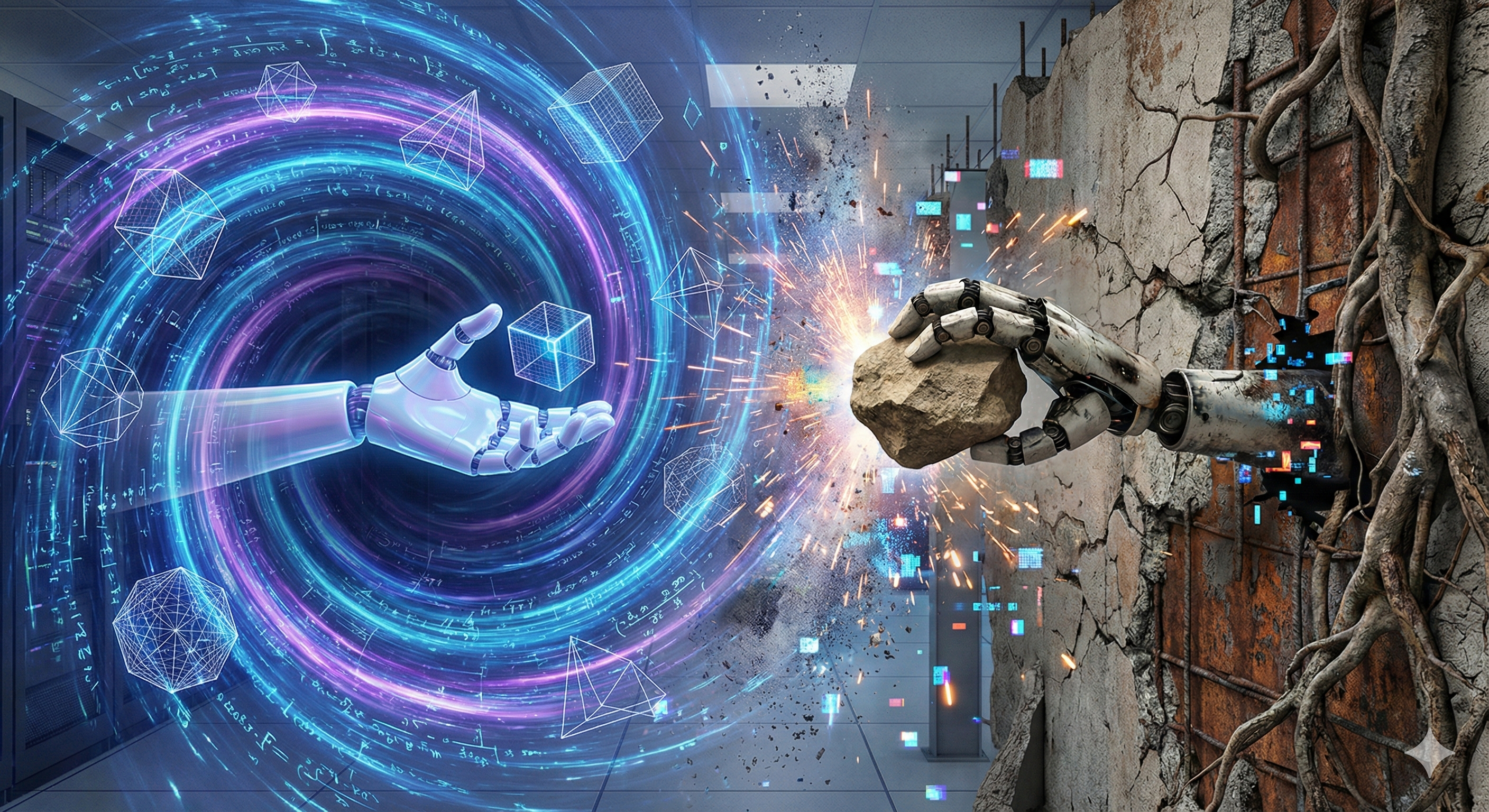
A robot that succeeded 100 times in simulation
fails every single time in reality.
This isn’t a bug.
It’s the natural result of a structural gap
that exists between simulation and reality.
This gap is called the Sim-to-Real Gap.
1. The Nature of the Gap: Why Simulation Isn’t Reality
Simulation is an approximation of reality.
No matter how sophisticated, it remains a model.
Physics engines calculate gravity and friction,
but they cannot capture every subtle variable of the real world.
The microscopic tilt of a floor.
Friction changes caused by air humidity.
Minute wear on robot joints.
These small differences accumulate
to produce entirely different outcomes.
As researchers note:
“Simulations consist of abstractions and approximations
that inevitably introduce discrepancies
between simulated and real environments.”
This is one of the reasons why Physical AI operates on fundamentally different structures than Software AI. The physics cannot be abstracted away.
2. Three Layers of the Gap
The Sim-to-Real Gap isn’t a singular problem.
It occurs across at least three distinct layers.
Visual Gap
Simulated images and real images are different.
The texture of rendered objects,
the direction and intensity of lighting,
the shape of shadows.
If a robot perceives the world through cameras,
this visual difference becomes the first barrier.
Google’s research team described this as
“pixel-level domain discrepancy.”
GAN-based techniques that transform synthetic images into realistic ones
were developed to bridge this gap.
Dynamics Gap
Physics engine calculations differ from real-world physics.
A friction coefficient set to 0.5 in simulation
might be 0.48 or 0.53 in reality.
Joint stiffness of a robotic arm,
mass distribution of objects,
subtle reaction forces during contact.
These dynamics differences are particularly critical
in precision manipulation tasks.
For industrial assembly robots,
when handling fit tolerances under 0.1mm,
policies learned in simulation
can fail completely in reality.
Sensor Gap
Simulated sensors are ideal.
Real sensors contain noise.
Camera lens distortion,
LiDAR reflection errors,
IMU drift.
Algorithms that received perfect data in simulation
become helpless before imperfect real-world data.
3. Strategies for Bridging the Gap
Researchers approach this gap from two main directions.
Making Simulation Closer to Reality: System Identification
Measure the physical parameters of the real world
and reflect them in simulation.
Measure the actual joint friction of the robot,
calculate the actual friction coefficient of the floor,
and input these into the simulator.
The problem is that accurately measuring every parameter
is practically impossible.
Environments constantly change.
Yesterday’s parameters may not apply today.
Embracing Real-World Variation: Domain Randomization
The opposite approach.
Instead of matching simulation to reality,
expose the robot to every possible variation in simulation.
“With enough variability in the simulator,
the real world may appear to the model
as just another variation.”
This is the core insight of Domain Randomization.
Randomly change lighting,
randomly alter object colors and textures,
randomly adjust friction coefficients and masses.
Learning in this chaotic environment,
robots gain generalization abilities
that don’t overfit to specific conditions.
OpenAI’s success in solving a Rubik’s Cube with a robot hand
was made possible by Domain Randomization.
4. Zero-Shot Transfer: Reality Without Retraining
The ultimate goal is Zero-Shot Transfer.
Taking a policy learned in simulation
and applying it directly to a real robot
without any additional training.
NVIDIA Isaac Lab was designed for this purpose.
Running thousands of environments simultaneously
with GPU-based parallel simulation,
systematically applying Domain Randomization,
and reducing dynamics gaps with high-fidelity physics engines.
In experiments with Boston Dynamics’ Spot robot,
locomotion policies trained in Isaac Lab
successfully transferred Zero-Shot to the real robot.
A robot that learned stair climbing in simulation
worked on real stairs.
5. Real-to-Sim-to-Real: A Circular Structure
Recently, more sophisticated approaches have emerged.
The RialTo system developed by MIT researchers
scans real environments with a smartphone,
reconstructs them in simulation,
then trains robots within that environment.
“The power of simulation is that
you can collect very large amounts of data.
In three hours of simulation,
we can collect 100 days’ worth of data.”
Reality → Simulation → Reality.
This circular structure narrows the gap from both directions.
Reflect reality into simulation,
learn thoroughly in simulation,
then transfer back to reality.
6. Will the Gap Disappear?
Not completely.
Simulation is inherently a model.
Models cannot contain everything about reality.
But reducing the gap to manageable levels
is already becoming reality.
This is why NVIDIA’s Cosmos trains World Foundation Models on 20 million hours of video data—encoding the kind of physical common sense that robots need to navigate the real world.
Making simulations more realistic,
while simultaneously training robots to be more robust.
Where these two efforts meet,
the practical realization of Physical AI begins.
Closing Thoughts
The Sim-to-Real Gap isn’t merely a technical problem.
It’s an ontological tension between abstraction and concreteness.
Simulation translates the world into mathematics.
That translation inevitably involves loss.
Domain Randomization acknowledges this loss
and turns that very uncertainty into a learning target.
“To a robot that has experienced sufficiently diverse simulations,
reality is just another variation.”
This paradoxical insight
has become the core strategy of Physical AI research.
Not eliminating the gap,
but learning to cross it.
That is the essence of Sim-to-Real research.
Leave a Reply